A Knife Box
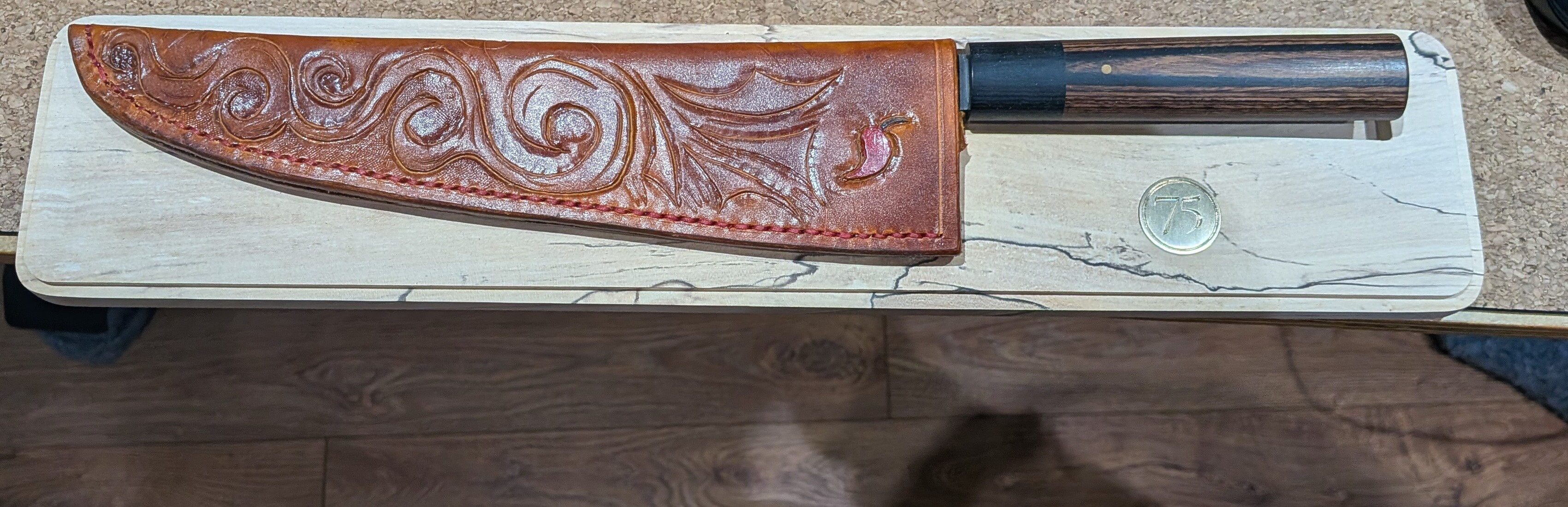
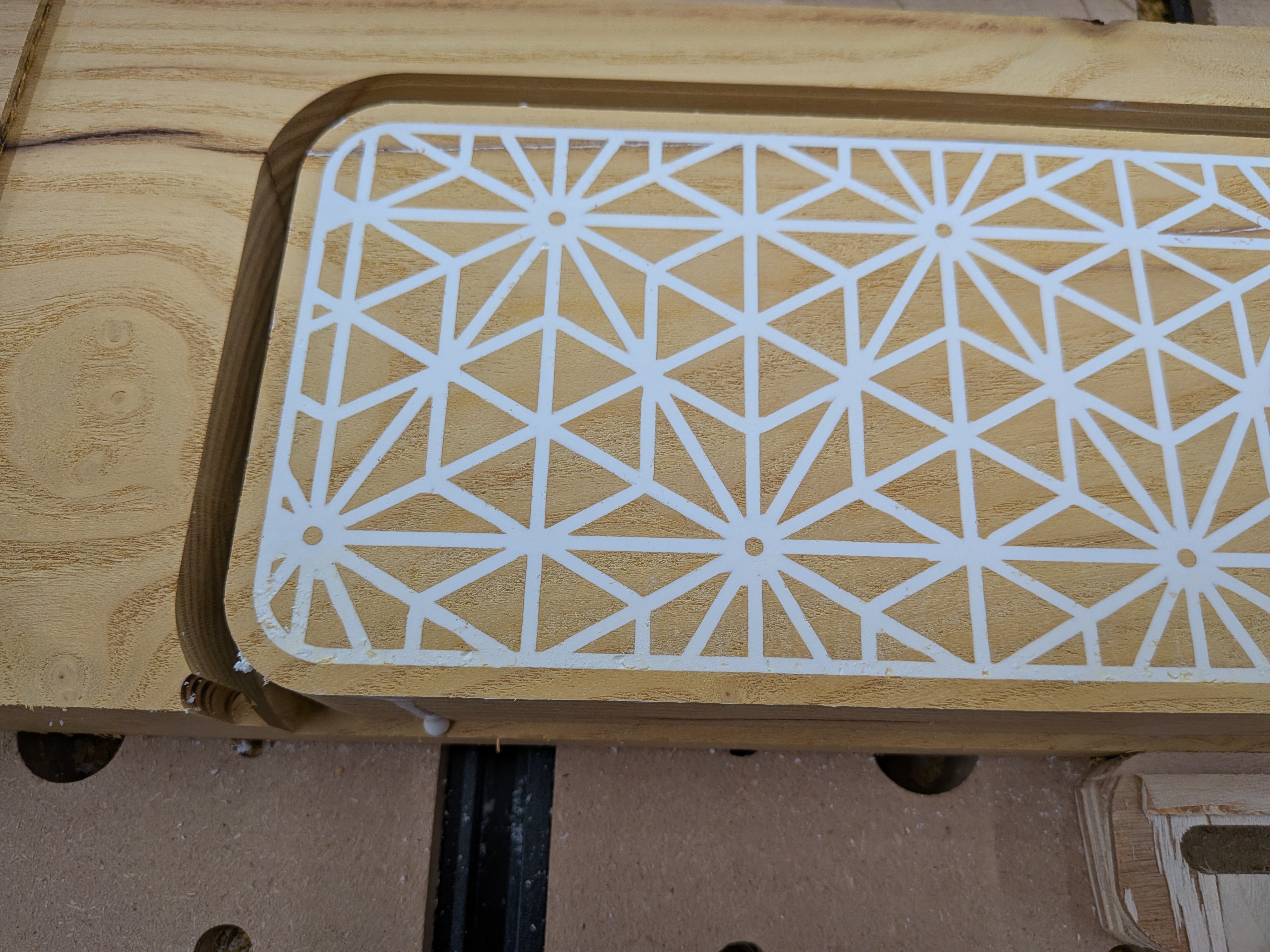
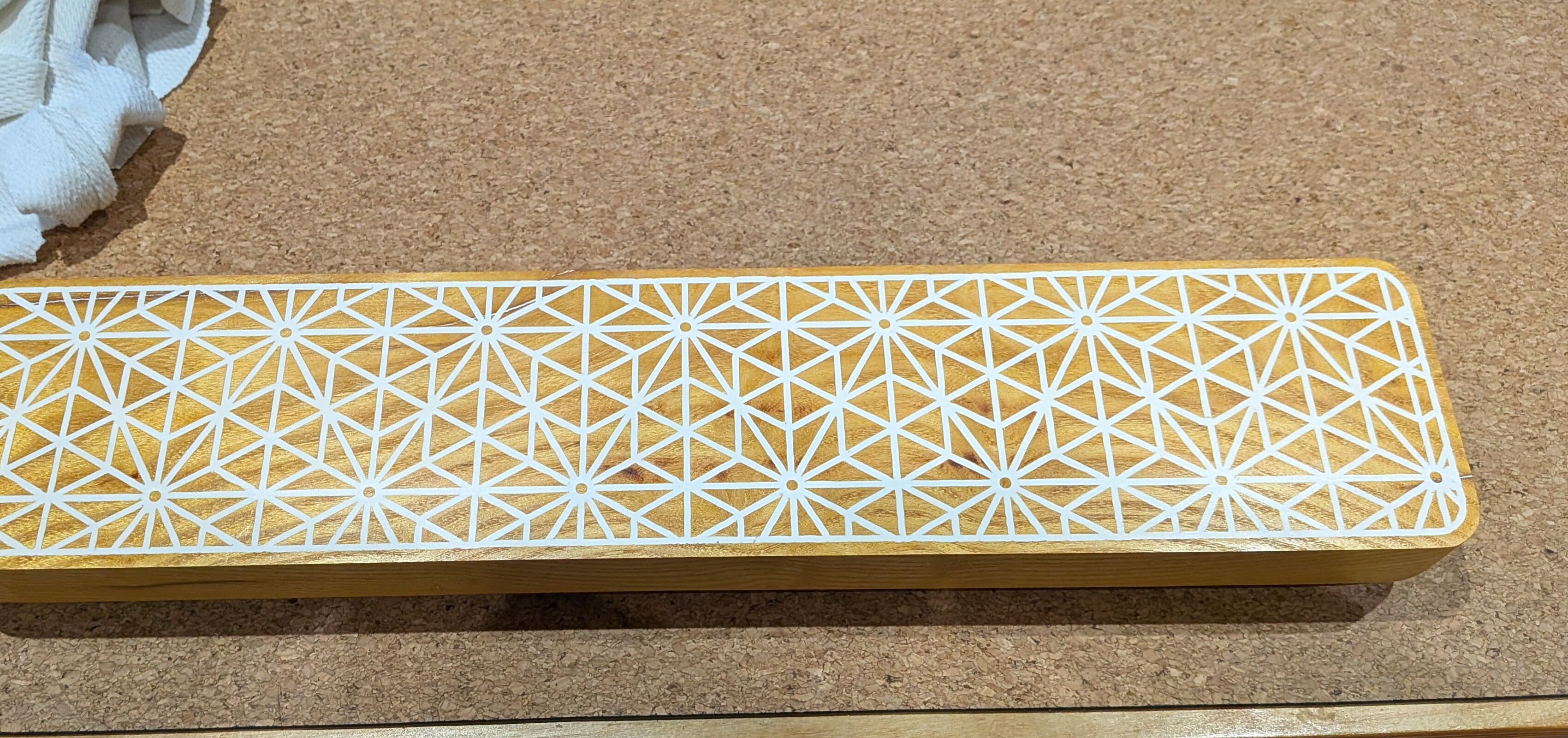
I made a knife box as a 75th birthday gift for Brian, through Whatsit Manufacturing Co.. It's a two-piece set – a spalted maple bed and a mulberry cover – sized to a specific Japanese chef knife and its tooled leather sheath. The cover has a traditional Asanoha pattern routed into the top face and filled with white dyed epoxy. A brass disc engraved with "75" sits in a pocket in the bed. The cover doubles as a display frame when flipped upside-down, with the mulberry border framing the spalted maple.
Mulberry starts almost saffron yellow when freshly cut and darkens over time toward something between cherry and walnut. The white epoxy will contrast well against either colour – bright and graphic now, warmer and more subtle later.
The Design
The whole box is parametric OpenSCAD, designed with Claude Code. All shared dimensions live in a central parameters file – bed size, pocket depths, clearances, fillet radii, pattern geometry – and propagate to every other file automatically.
The bed is 436mm long, 85mm wide, and 14mm thick with 10mm rounded corners – just under half a metre, sized to the specific knife. It has a trapezoid pocket shaped to match the knife handle's taper: 135mm long, 30mm on the handle side and 27.5mm on the blade side, 10mm deep with 2mm corner radii. A circular pocket next to the handle (25mm diameter, 2.4mm deep) accepts the brass disc. The pocket is 0.1mm shallower than the 2.5mm disc stock, so the disc sits slightly proud and can be sanded flush after installation. The disc itself is V-carved with "75" inside a circle border, in Cormorant SC Medium – a serif typeface from Google Fonts with small caps that works well for formal engraving.
The bed has a three-layer stepped profile rather than a simple slab. There's a lip on the top and bottom, with a wider flange in the middle that matches the cover's outer dimensions. The lips locate into the cover's recess; the flange sits flush with the cover's edge. This works in both orientations – cover on top for storage, cover flipped upside-down for display. In display mode, the bed drops into the upside-down cover, and the mulberry border frames the spalted maple. The 0.2mm clearance provides enough friction to hold the pieces together without hardware.
The cover is cut from 30mm mulberry stock, roughly 446mm × 95mm – 5mm of wall thickness plus 0.2mm of clearance per side larger than the bed. The interior has a 3mm bed recess around the perimeter where the lip seats, then a uniform 26mm deep cavity inside that clears the knife handle and leather sheath. The deepest point of the cavity leaves 3.8mm of solid mulberry between the inside and the Asanoha pattern on the top face.
Both pieces have filleted edges – 3mm quarter-round on the cover's outer edges (top and bottom), 1.5mm on the bed's top edge and the cover's inner recess. OpenSCAD has no native fillet operation, so these are approximated by stacking thin slices whose profiles follow a quarter-circle curve. The cover fillet makes it easy to pick up from either orientation; the matching bed and recess fillets hide the seam where the two pieces meet.
The Asanoha Pattern
Asanoha is a traditional Japanese geometric design based on hemp leaves, common in textiles, lattice screens, and woodwork since at least the Edo period. It's built almost entirely from straight lines intersecting at regular angles, which makes it well suited to CNC routing – a repeating grid of line segments with no variable widths.
The pattern is built from a hexagonal grid with a 35mm circumradius, pointy-top orientation. Each hexagon is divided into six triangles by spokes from center to vertices. Within each triangle, three lines radiate from the midpoint of the hex edge – one to the hex center and two to the midpoints of the adjacent spokes – creating the characteristic starburst at every hex-edge midpoint. That's 30 line segments per hexagon: 6 edges, 6 spokes, and 18 inner lines. A small circle of material (1.5mm radius) is preserved at each hex center where all the spokes and inner lines converge – without it, the intersection of twelve lines would leave almost no material at the center.
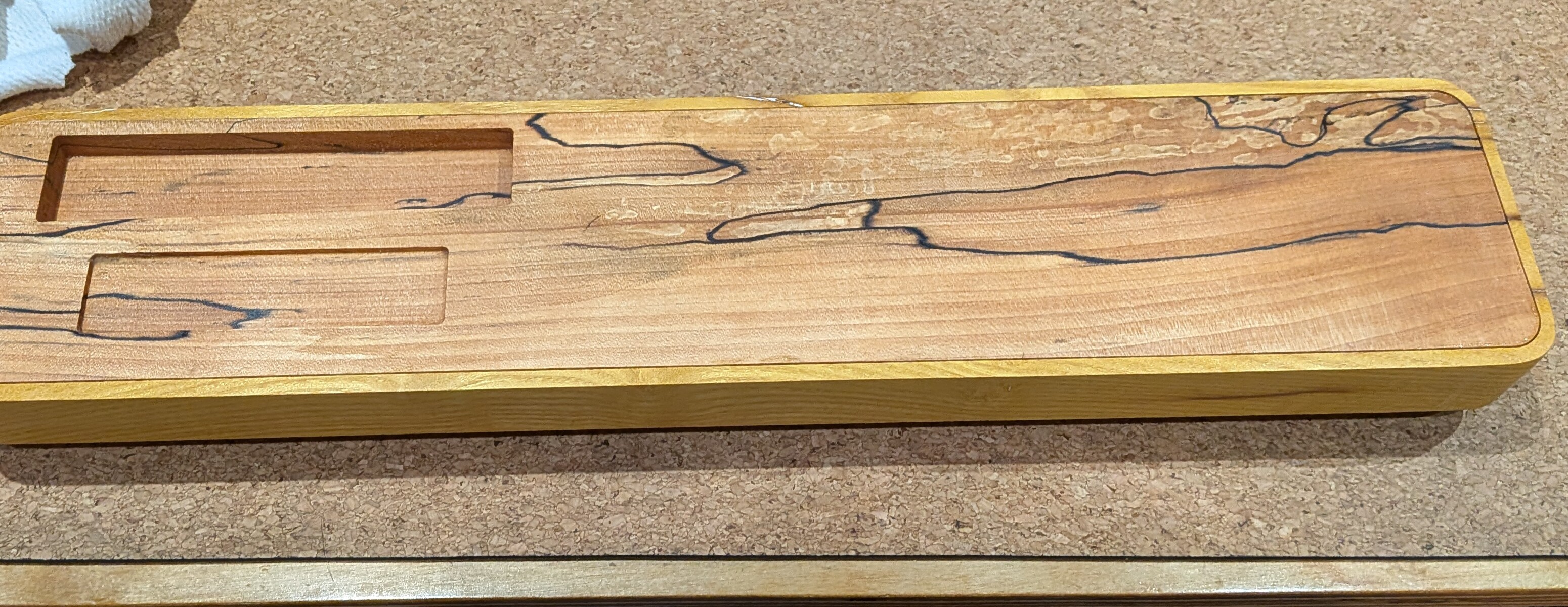
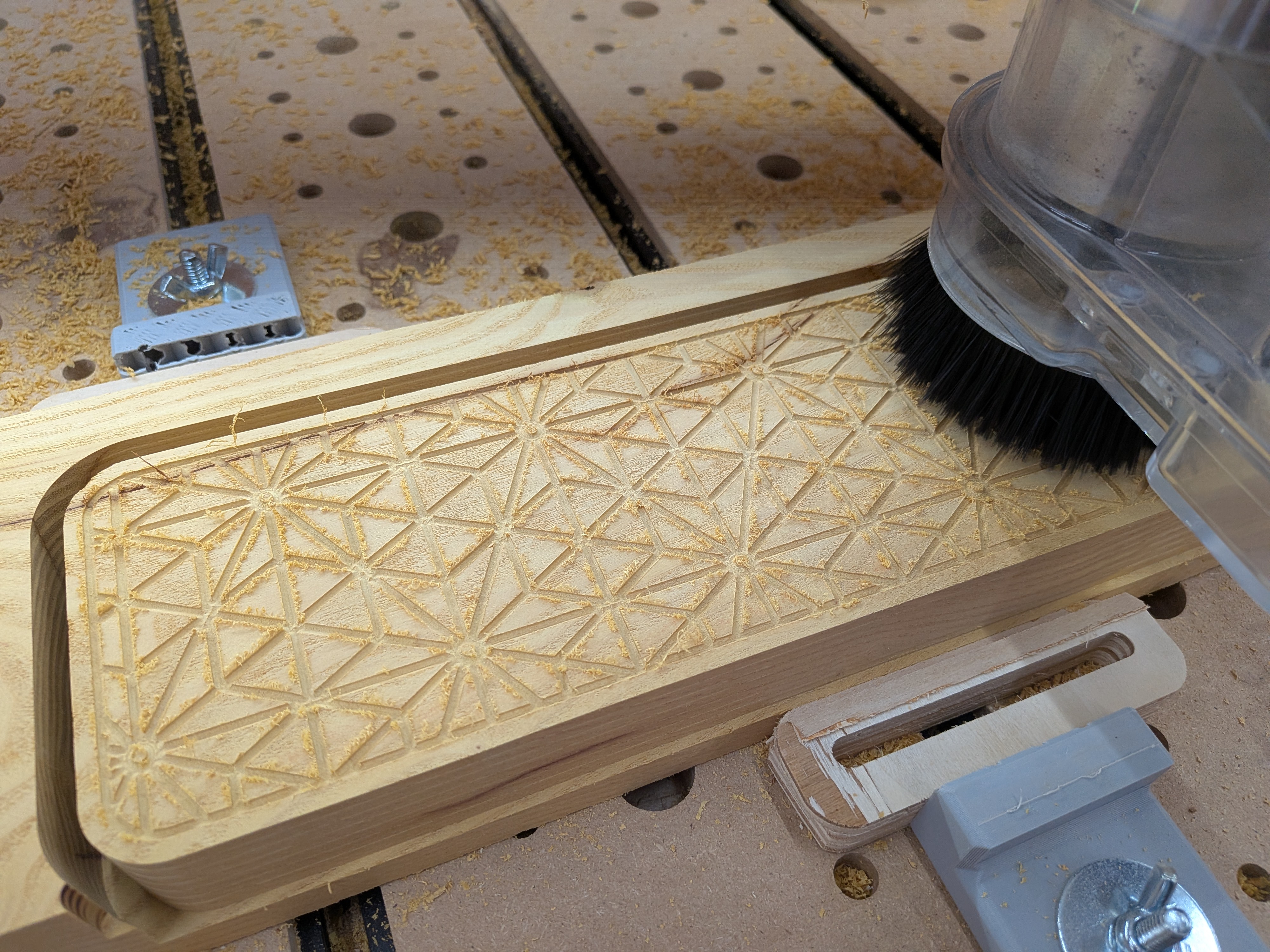
The lines are 2.05mm wide – 0.05mm wider than the 2mm endmill, so the bit can slot into the channels. A 2mm border frame sits inset 5mm from the cover edge, matching the cover's wall thickness. The hex grid overshoots the cover bounds and is clipped to the border's centerline, so pattern lines overlap the border by half a line width. This creates seamless T-junctions where the pattern meets the border instead of visible gaps. The grid is offset by half a row vertically so that two rows of hex centers straddle the horizontal center line, keeping the pattern visually centered on the cover.
The inlay is white dyed West Systems epoxy. After routing the pattern 2mm deep into the cover surface, I dammed the border with painter's tape and filled the channels with epoxy. Once cured, the surface was sanded flush. The epoxy fills only the routed channels – the mulberry surface between them is untouched, so the final result is a crisp boundary between wood and epoxy with no bleed or overlap.
Manufacturing
Everything was CNC-routed on my LongMill, with all toolpaths generated in MapleCAM. The OpenSCAD 2D profiles were exported as SVGs and imported into MapleCAM.
The bed is the simpler piece – pocket the handle recess, pocket the brass disc recess, profile the outside with rounded corners, and fillet the top edges.
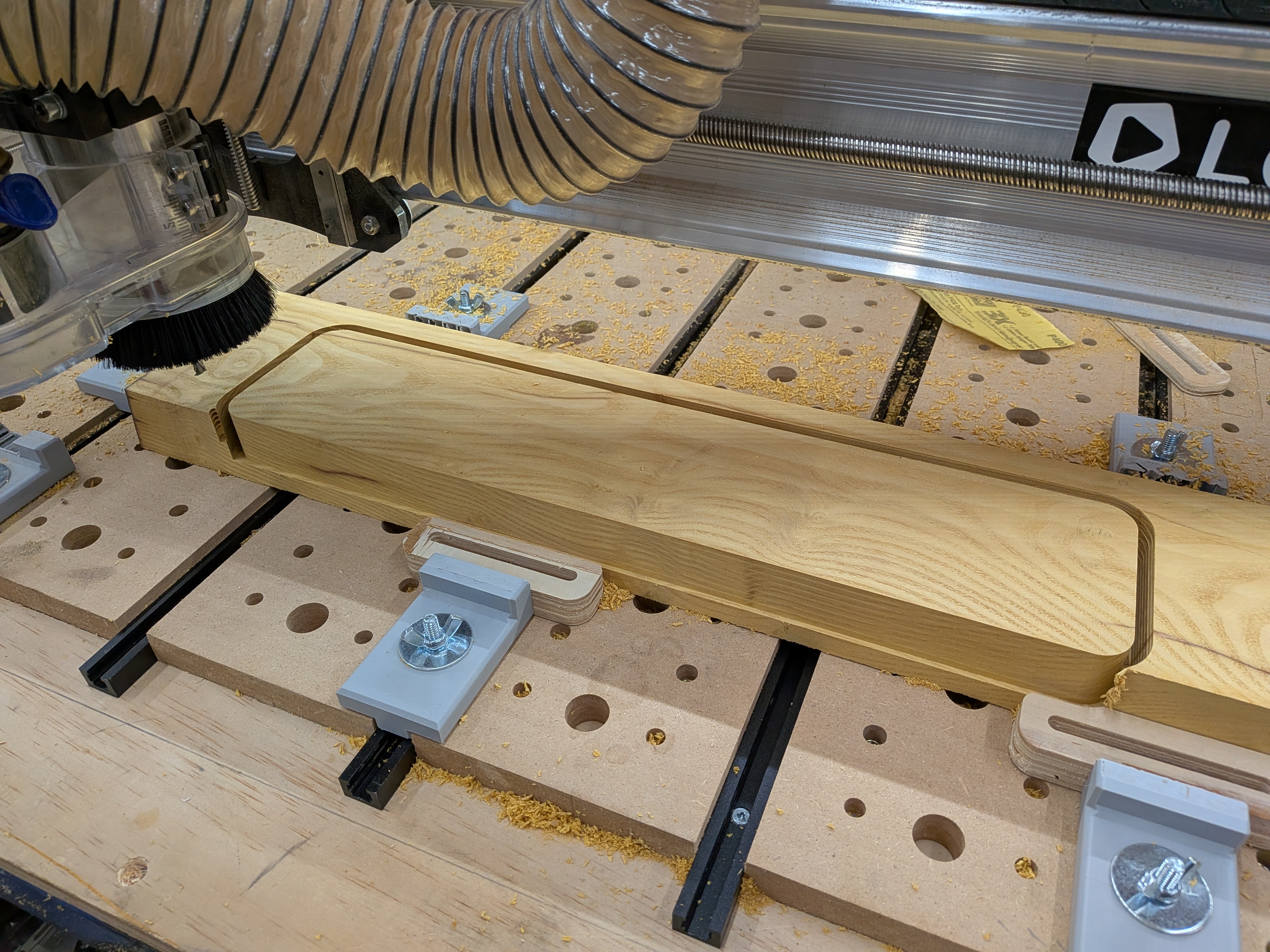
The cover required more operations and two sides of work. The bottom side gets the interior cavity and bed recess, then the outside profile with fillets. After flipping, the top side gets the Asanoha pattern – hundreds of small pockets at 2mm depth with the 2mm endmill. The pattern routing was the slowest single operation.
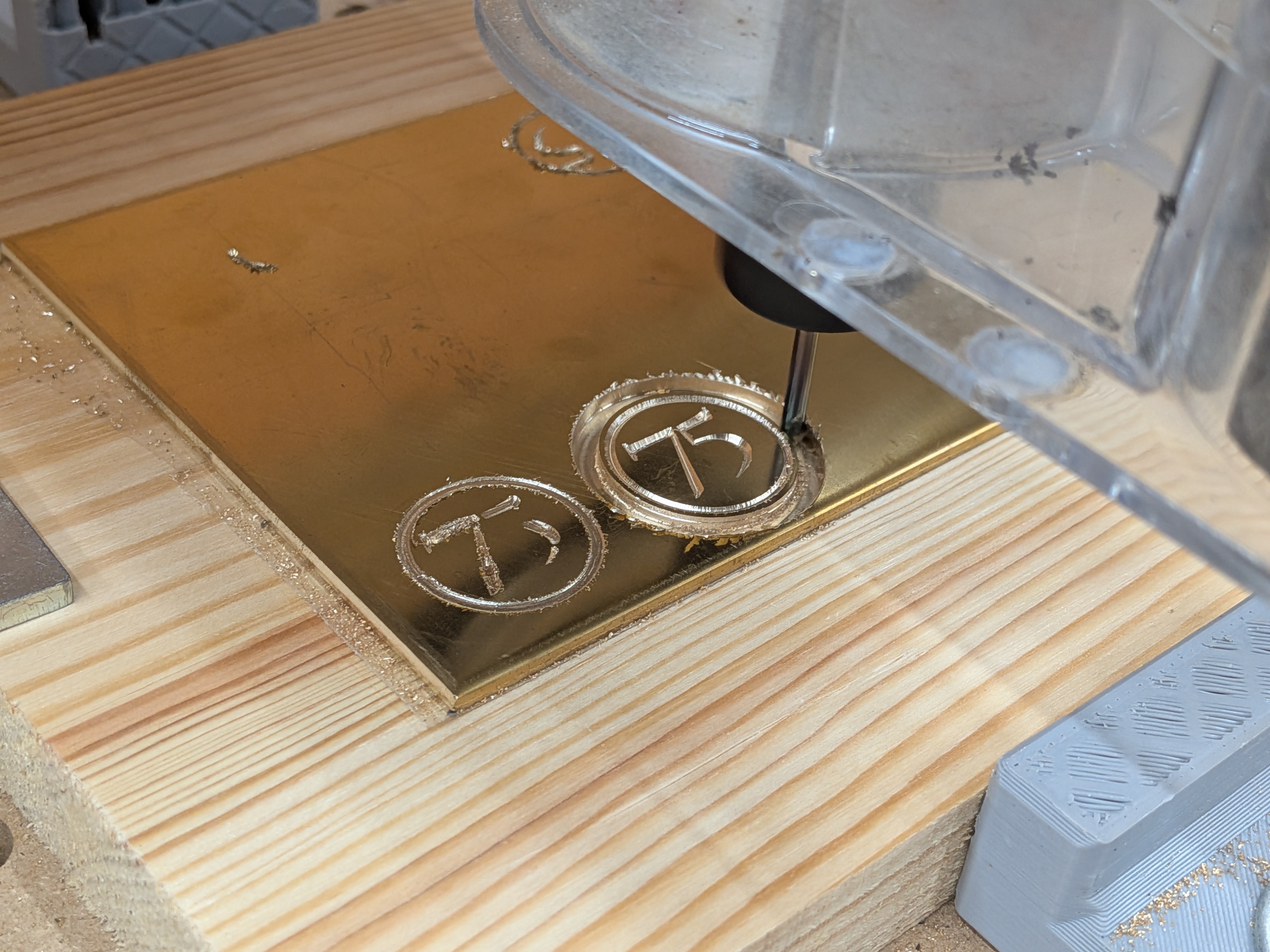
The brass disc was V-carved with "75" – similar to the brass work on the Scuttlebutt awards but done entirely in MapleCAM with a V-bit.
After machining, everything was sanded to 600 grit and finished with mineral oil and beeswax.